
The Swedish Coast Guard prepares for the future ahead
12 August 2025 14:00
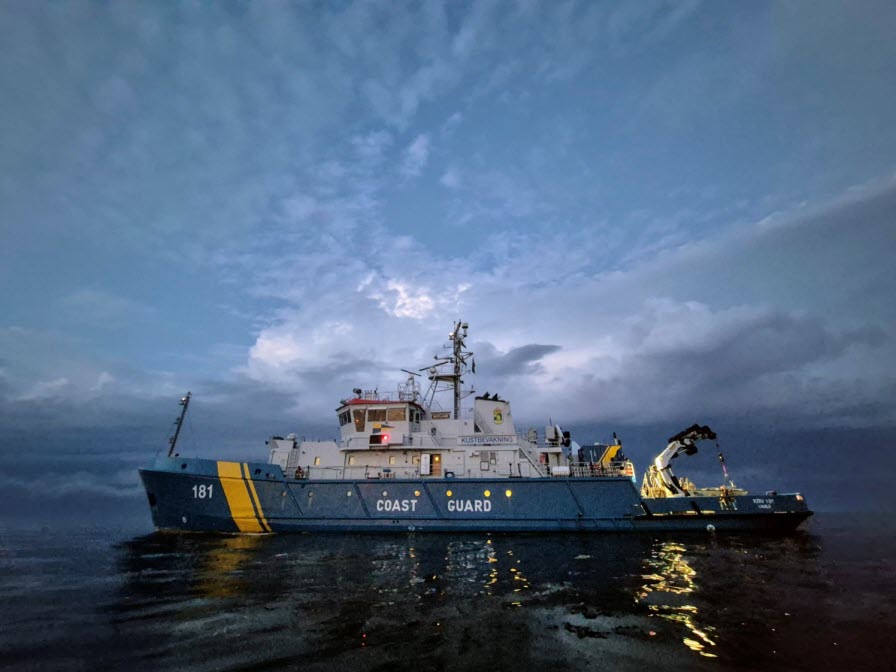
The Swedish Coast Guard faces increasingly complex maritime risk and threat scenarios involving disruption to vital societal functions and critical infrastructure, escalating environmental risks, cyberthreats and challenges to national security. This places high demands on the agency’s organisation. New government assignments, an increased budget, more personnel and ongoing development work will make the organisation even more effective going forward.
“The fundamental role of the Swedish Coast Guard is to maintain the capability to perform the agency’s assignments to provide rescue services and conduct maritime surveillance, with all that this entails. This is a busy time for the Swedish Coast Guard and we are now beginning activities and work in preparation for the autumn. Our newly adopted planning strategy will be our roadmap. In an altered global situation, our strategy will help us to be even more astute when prioritising and targeting our operations,” says Director General Lena Lindgren Schelin.
Reinforcing the self-defence capabilities of seagoing platforms
In June, the Swedish Coast Guard was given a government assignment to reinforce the self-defence capabilities of the agency’s seagoing platforms against various types of threat that may arise in the maritime environment. The present global situation places greater demands on the Swedish Coast Guard to increase its capability to protect vessels and crews within Sweden’s total defence.
“We take a positive view of this and we are analysing how self-defence can be reinforced in both the short and long terms. For example, it may involve technical equipment and non-standard-issue weapons. Among other things, we are determining which resources we will need to develop in the short and long term, such as materials, training and personnel, as well as the economic and legal conditions, but we are working to strengthen security and endurance in the organisation on an ongoing basis,” says Schelin.
A hub for maritime situational awareness
One of the most important issues for the Swedish Coast Guard at the moment is developing civil maritime situational awareness. The Swedish Coast Guard is one of several marine resources and, in addition to collaborating on and coordinating maritime situational awareness, the agency is also a central partner when vessels and resources need to be mobilised to provide assistance.
“We are working to improve the conditions for collecting, analysing and sharing information. An up-to-date analysis of the maritime situation is essential to flexibility and to ensuring that the Swedish Coast Guard can prioritise correctly based on current threat and risk scenarios. Sharing our civil maritime situational awareness and our analyses with relevant partners is at least as important if they are to effectively fulfil their assignments in the maritime arena,” says Schelin.
Four operational focus areas during the autumn
The Swedish Coast Guard is also allocating additional resources to four operational focus areas: protecting maritime infrastructure, contributing to the fight against organised crime, continuing to enforce sanctions against Russia, and developing fishery inspections within the agency’s area of responsibility. The agency also has separate government assignments in some of these areas.
“Given our uncertain and complex external environment, we need to prioritise and target the agency’s operations in a more dynamic manner than we have done previously,” says Pär-Åke Eriksson, Head of the Swedish Coast Guard’s Operations Department.
Critical undersea infrastructure and sanctions against Russia
The Swedish Coast Guard has a role in protecting critical undersea infrastructure against physical attacks and sabotage by foreign powers. This work is carried out in collaboration with other Swedish and international agencies.
“To this end, the Swedish Coast Guard collaborates with the NATO initiative Baltic Sentry, which has increased surveillance of critical undersea infrastructure over the last year. We are the Swedish point of contact for the network within NATO, a task undertaken in close cooperation with the Swedish Armed Forces,” explains Eriksson.
The Swedish Coast Guard is also working actively to ensure compliance with sanctions against Russia.
“We support Ukraine by restricting Russian trading capacity within the EU and NATO by ensuring that these sanctions are observed. From 1 July, the Swedish Coast Guard may request information from shipping regarding a vessel’s insurance cover, making it easier for us to intervene,” says Eriksson.
Organised crime has a negative impact on societal functions
Organised crime is another threat to society and its functions that has both a direct and indirect negative impact on people’s safety and security.
“The Swedish Coast Guard is especially focused on these areas through our presence in ports and our cooperation and specific interventions conducted with other law enforcement agencies. We have personnel whose sole focus is the supervision of shipments through ports, with the aim of increasing security, preventing accidents and detecting crime,” says Eriksson.
Fishery inspections for sustainable fishing
One key part of the Swedish Coast Guard’s operations is the fishery inspections conducted at sea to ensure that both commercial and recreational fishing vessels comply with applicable legislation. This involves the inspection of fishing equipment, catches and logbooks.
“Our inspections prevent illegal fishing and protect fish stocks for future generations. We have a separate expert group on fisheries at the agency. One important element is the inspections we conduct with other EU Member States as part of Joint Deployment Plans. These inspections are conducted in collaboration with the European Fisheries Control Agency and regulated in joint EU regulations.”
Many important issues are on the agenda and the Swedish Coast Guard is in the middle of major change work in order to continue to develop the agency's capabilities from several directions.
“We are currently working on a journey of change for the agency, but also for society. These challenges demand that we create favourable conditions for dialogue and communication in our networks, both internally and with other stakeholders,” concludes Eriksson.
Changed 23 December 2025 13:17