

About the basic training
The first step to becoming a Coast Guard Member is the Swedish Coast Guard's basic training. It consists of both theory and practice and takes place largely on site in Karlskrona. The basic training lasts at most about 2 years, with a paid monthly salary.
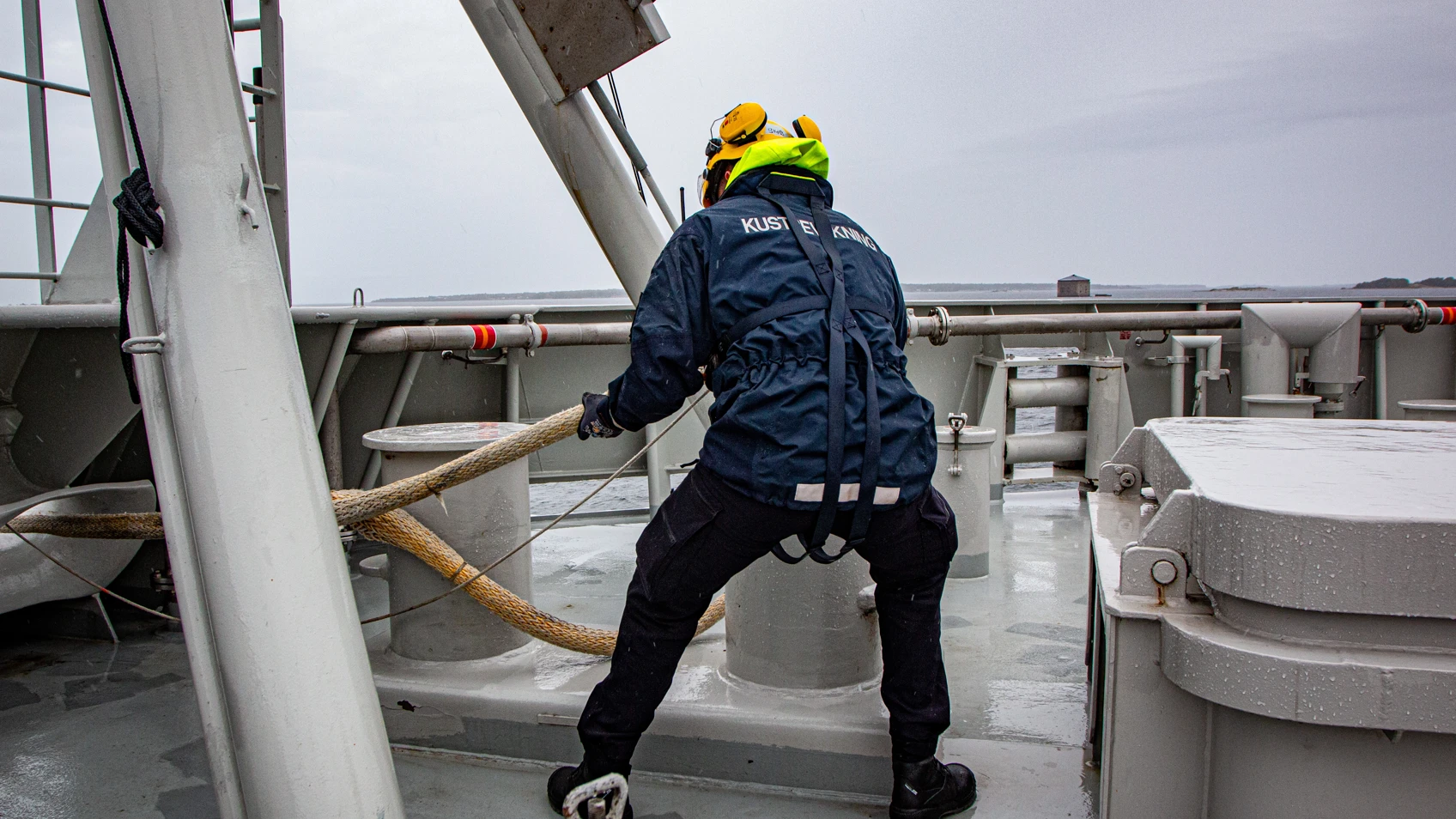
The training starts with one year in Karlskrona and continues with six months of sea placement. If you do not have the Class VII vessel officer course, you also study a final term in Gothenburg.
First year in Karlskrona
You study on site in the Coast Guard's training facilities and alternate theory with practical exercises. You learn about the laws that govern the work and your powers as a Coast Guard Member.
The training covers law enforcement, border control, fisheries surveillance and maritime safety, among other things. You are also trained in rescue services, seamanship, self-protection, service weapons and cardiopulmonary resuscitation (CPR).
There is something very meaningful in contributing to both safety and the environment, while working in a strong team. It is a profession where you get to make a difference, every day
Johanna, Coast Guard Member
Third term – sea placement
For six months you do a sea placement on board our vessels at one of our coast guard stations along the Swedish coast. There you put your knowledge into practice in daily work.
Fourth term – Class VII vessel officer course
If you do not have the Class VII vessel officer course, you take it at Chalmers School of Maritime Studies in Gothenburg. If you have already taken the course, you do not need to take it again.
The course is worth 40 higher education credits and includes navigation, seamanship, cargo handling, communication and safety on board, among other things.
News!
The Class VII engineer officer course is no longer part of the basic training. It is instead offered as further training after graduation. This means the training is now about 2 years at most, instead of 2.5 years.
After the training
After you have completed and passed the training, your employment becomes a permanent position at one of our coast guard stations along the Swedish coast.
Our fleet of vessels is spread across the whole country. The tasks, and the type of vessel, differ to some extent depending on where you are stationed. You can request a place of work, but you are always posted where operational needs are greatest.
Activate movie-cookies to watch the movie Malin berättar om sitt jobb som kustbevakare, och numera teknisk chef (maskinist)
Possible career paths as a Coast Guard Member
After the basic training you can continue your education in several different areas of expertise. For example, you can apply to the Coast Guard's diving organisation, or to the role of On Scene Commander or Head of Technology (engineer).
You can also apply to the Coast Guard's airborne units, as System Operator or Pilot. There is also a drone pilot training course, and there are opportunities to be part of expert groups in areas such as fishing. If working on land and in an office appeals to you, you can apply for Administrator posts or other office-based positions. Perhaps you are a future Station Master or Head of Unit in the Operations Department?
In other words, your career path after the basic training as a Coast Guard Member is broad, and there are many opportunities to continue along the path that suits you best.
Frequently asked questions
The next application period for the Coast Guard's basic training is planned for spring 2027. The training starts in August.
Because the Coast Guard pays for the training, we do not train more people than we intend to employ. To be given a permanent position after the training, the Coastguard Trainee must pass all parts of the theoretical training and be assessed as suitable as an officer during training and placement.
A placement on one of the Coast Guard's vessels is part of the basic training.
Beyond that, we are unfortunately unable to host trainees in our operational activities.
The Coast Guard takes part in missions abroad and international operations. The employment therefore includes an obligation to serve abroad when the operation requires it. As a Coast Guard Member you can also choose to apply for longer service abroad within our assignment for Frontex, but this is not required.
You apply for a place on the basic training by submitting your application through the current recruitment advertisement, when one is published.
Before a new recruitment round starts, information is published here on Kustbevakningen.se. The advertisement is also published with the Swedish Public Employment Service (Arbetsförmedlingen) and through the recruitment tool Varbi. The next recruitment period is planned for spring 2027.
While you study the basic training, you are classed as a Coastguard Trainee and earn SEK 29635 per month. After graduation, if you have completed the training with a pass, you are offered a permanent position as Coastguardsman. You then earn at least SEK 34060 per month in individual salary (review autumn 2026).