
Working in the air patrol
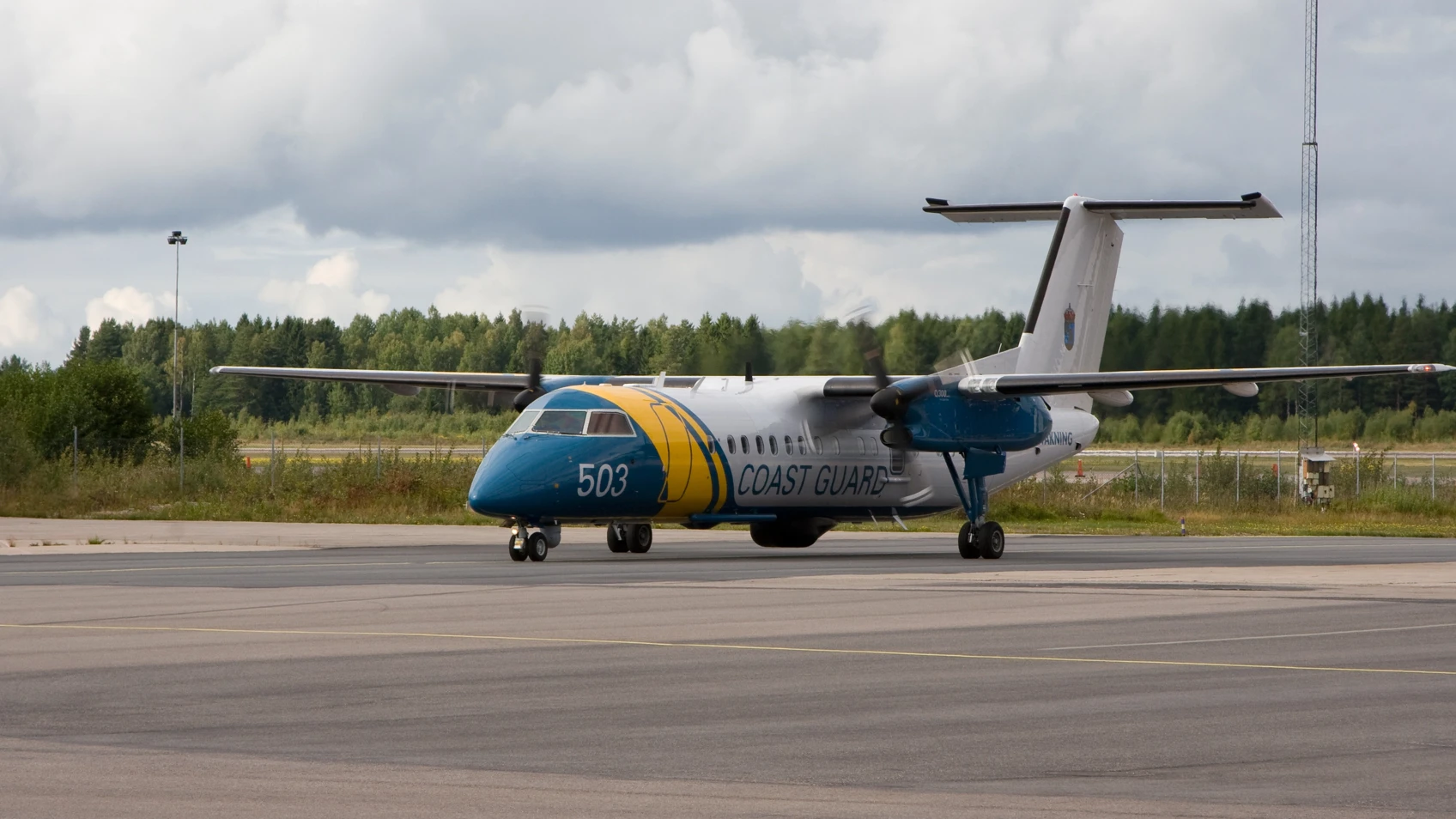
The Swedish Coast Guard air patrol is an invaluable part of Sweden's maritime crisis preparedness. With three advanced Dash 8 Q-300 aircraft based at Skavsta in Nyköping, it carries out surveillance every day, along the whole Swedish coast and over Lake Vänern and Lake Mälaren. The air patrol has existed since 1976 and provides high preparedness for both environmental and search and rescue operations at sea, as well as for international missions.
Part of total defence
Maritime preparedness in Sweden is strengthened by verifying the situational picture in real time and sharing information with other government agencies, especially the Swedish Armed Forces. The Swedish Coast Guard air patrol works closely with the Navy every day.
The main tasks of the air patrol
We have high preparedness to save lives and the environment. From the air, we locate people in distress and guide vessels in complex search and rescue operations. We can also drop life rafts from the air to people in the water.
The main mission of the Swedish Coast Guard air patrol is to carry out maritime surveillance across the whole of the Coast Guard's area of operations. It is the single most important sensor for creating an up-to-date maritime situational picture, and it covers very large areas in a short time. Maritime surveillance includes a number of other tasks, which are listed below. One of the greatest strengths of the air patrol is its ability to carry out several different missions at the same time.
With advanced sensors, we detect oil spills and chemicals even in darkness and bad weather. We are often first on the scene and lead the clean-up work.
We check that fishing rules are followed over open sea areas and on Lake Vänern and Lake Mälaren, to contribute to sustainable fishing.
We combat smuggling and environmental crime, and we are an important player in the work against serious organised crime, in cooperation with Swedish Customs and the Police Authority.
We monitor the sea borders and react immediately to deviations, for example if a vessel switches off its positioning system (AIS) or suddenly changes course.
We share our situational picture in real time with the Navy to strengthen total defence. The air patrol also carries out regular international missions under various agreements, mainly concerning environmental and fishing surveillance.
Global expertise and advanced technology
The Coast Guard's aircraft are equipped with several sophisticated surveillance systems. They are among the most advanced civil aircraft for maritime surveillance in the world. They are built by the Canadian company De Havilland and modified by Field Aviation in cooperation with the American company L3 Communication. The Dash 8 Q-300 has a long range, good performance and optimal working conditions for the crew.
Place of work and location
The Coast Guard has 20 coast guard stations around the Swedish coast, on Lake Vänern and on Lake Mälaren – but air operations are based entirely at Skavsta. This is where the Coast Guard's air coast guard station is located, and your permanent base as a system operator.
About the role of system operator
As a system operator, you are part of a crew of two pilots and two system operators. You are responsible for the aircraft's surveillance and documentation systems, and for communication by radio and other systems.
The work is done in close cooperation with the rest of the crew. It requires sensitivity to others, team spirit and the ability to make independent decisions. With us, you use your skills to make a real difference to people's safety and to the marine environment – every day.
All system operators must be trained coast guard officers. People who are recruited externally therefore need to complete the Coast Guard's basic training.
The Coast Guard's basic training lasts between 1.5 and 2.5 years, depending on your prior knowledge. It gives you a secure introduction and the chance to develop together with skilled colleagues.
The theoretical studies in Karlskrona are combined with practical sea service at one of our coast guard stations. After that, you take about four months of specific system operator training at Skavsta.
- We are looking for someone with good judgement who takes responsibility and enjoys working closely with others.
- General entry requirements for higher education studies.
- Swedish citizenship.
- Category B driving licence without restrictions for automatic transmission.
- Good knowledge of Swedish and English, both spoken and written.
- A valid 2-year medical certificate for seafarers in unlimited trade (group 1 deck safety crew, TSFS 2011:117).
- The employment also requires a passed drug test and a security clearance under the Protective Security Act.
We are like a sensor ourselves. We see vessels that change course, slow down or switch off their AIS, the Automatic Identification System. This is not always illegal, but it can be a sign of something that needs attention.
Krister Lundgren, system operator with long experience at sea.
About the role of pilot
As a pilot, you are part of a crew of two pilots and two system operators. The work is done in close cooperation with the rest of the crew. It requires sensitivity to others, team spirit and the ability to make independent decisions. With us, you use your skills to make a real difference to people's safety and to the marine environment – every day.
There are currently two main routes to becoming a pilot in the Coast Guard. Either we recruit coast guard officers internally and then train them to become pilots, or we recruit fully qualified pilots externally. All pilots must be trained coast guard officers. Those who are recruited externally will therefore complete the Coast Guard's basic training
The basic training lasts between 1.5 and 2.5 years, depending on your prior knowledge. It gives you a secure introduction and the chance to develop together with skilled colleagues.
The theoretical studies in Karlskrona are combined with practical sea service at some of our coast guard stations. After that, about 6 months of specific training follows, including a so-called Type Rating. In some cases, this training can be completed before the basic training.
- We are looking for someone with good judgement who takes responsibility and enjoys working closely with others.
- General entry requirements for higher education studies.
- Swedish citizenship.
- Category B driving licence without restrictions for automatic transmission.
- Good knowledge of Swedish and English, both spoken and written.
- Commercial Pilot License - CPL(A)
- ATPL Theory
- Instrument Rating - IR(A)
- Multi Crew Cooperation – MCC
- EASA FCL class 1
- Advanced UPRT (if you have not previously completed a type rating)
You must have passed the aptitude test for pilots held at the Swedish Armed Forces HR Centre special selection (FM HR C). If you have not previously completed this, the tests will be paid for by the Coast Guard after an initial selection.
The employment also requires a passed drug test and a security clearance under the Protective Security Act.