
Boarding of unseaworthy vessels
After changes in the law on 1 March 2026, the Swedish Coast Guard gained greater opportunities to carry out effective intelligence work, which gave a better basis for decisions before taking action. We were then able to take action against – board – several vessels with unclear flag status and suspected of being unseaworthy, an offence under the Swedish Maritime Code.
In recent years, the Swedish Coast Guard has seen an increase in foreign vessels with unclear flag, ownership and insurance arrangements in Swedish waters. The purpose of these so-called shadow vessels is to get around sanctions imposed by the EU and other countries, so that they can continue sea transport to and from Russia. As a result, more of the vessels in Swedish waters are judged to be in poorer condition, with crews whose seamanship can be questioned. Poor safety, maintenance and competence on board these vessels are a threat both to the environment and to other maritime traffic.
In 2026, the Coast Guard has taken action against – boarded – several vessels with unclear flag status that were therefore suspected of being unseaworthy, which is an offence under the Swedish Maritime Code.
Taking action against vessels that claim the right of innocent passage requires careful analysis and deliberate decisions. It must be done with legal certainty, with a clear basis in Swedish and international law, and in close and well-functioning cooperation between agencies.
Changes in the law
Since 1 March 2026, a number of changes in the law have given the Coast Guard greater opportunities to carry out effective intelligence work. This makes it possible to build a better basis for decisions before taking action.
The Coast Guard follows vessel traffic in the Baltic Sea around the clock, and we exchange information with several other agencies in this work. We will continue to take action when the situation requires it.
Through our maritime situational picture and our analyses, the Coast Guard can see that, after the actions taken by Swedish authorities in spring 2026, more vessels with unclear flag state are now choosing a route other than through Swedish territorial waters. We assess that this trend will continue.
The boarded vessels
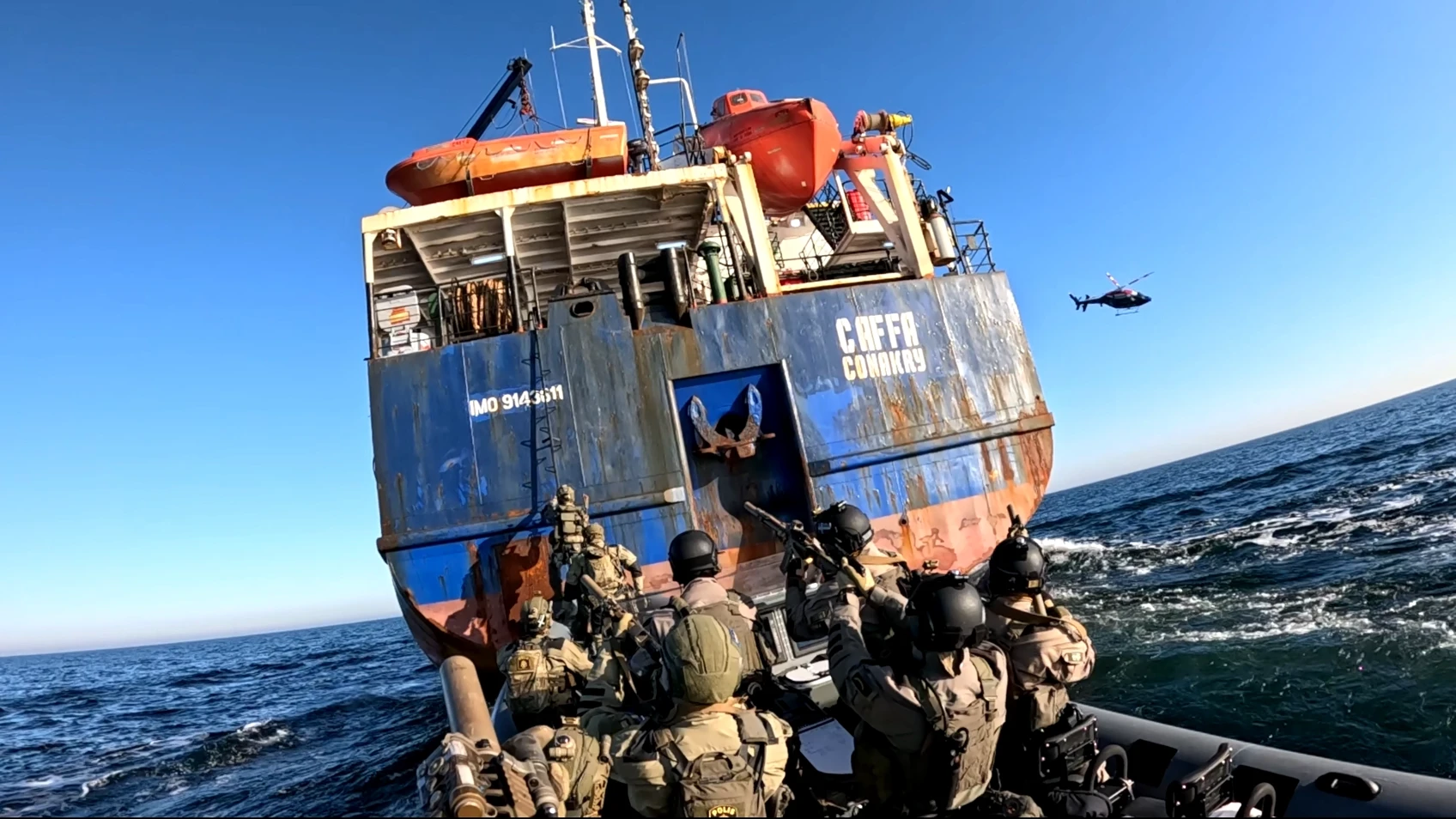
On 6 March 2026, the Coast Guard took control of the bulk carrier Caffa, which had unclear flag status. The operation, supported by the Swedish Police Authority, took place in the Baltic Sea in Swedish territorial waters south of Trelleborg. The master was detained on suspicion of aggravated use of a forged document, but was later released.
Caffa was suspected of having been used to transport stolen grain from Russian-occupied areas of Ukraine. Ukraine therefore requested that the vessel be seized. In June 2026, the district court decided that the vessel may be handed over to Ukraine, and the court of appeal later made the same decision. The Supreme Court has rejected the shipping company's appeal. Caffa is in Trelleborg harbour under a prohibition on use.
On 12 March 2026, the Coast Guard, supported by the Swedish Police Authority, boarded the tanker Sea Owl I off Trelleborg. The reason for the boarding was suspicion of an offence against the Swedish Maritime Code concerning unseaworthiness and a false flag state. Two masters of Sea Owl 1 were detained on suspicion of presenting false certificates, but were later released.
On 12 October the prohibition on use was lifted and Sea Owl I has left Swedish waters.
On 3 April 2026, the Coast Guard boarded the tanker Flora 1 on suspicion of an oil spill in international waters. The vessel is on the EU sanctions list and we found several unclear circumstances concerning the vessel, including its flag status. The vessel was given a designated anchorage south of Ystad.
The investigations showed that environmental crime could not be proven, and Cameroon confirmed that the vessel is registered in its ship register. There were therefore no grounds for further investigative measures. Flora 1 was allowed to leave its position off Ystad on 4 April.
On 11 April 2026, while surveilling the Baltic Sea, the Coast Guard air patrol discovered that the Panama-flagged bulk carrier Hui Yuan was washing coal residues into the sea. This is an offence under the Environmental Code. On behalf of the Swedish Prosecution Authority, the Coast Guard boarded the vessel on 12 April. The master of Hui Yuan admitted the offence under the Environmental Code and deposited money for future fines. The vessel was then allowed to leave Sweden.
On 3 May 2026, the Coast Guard, together with the Swedish Police Authority, boarded the tanker Jin Hui south of Trelleborg. The reason for the boarding was a suspected false flag, which led to suspicion of unseaworthiness under the Swedish Maritime Code, and a preliminary investigation was therefore opened. The master was detained on suspicion of aggravated use of a forged document, but was later released. Jin Hui is off Trelleborg under a prohibition on use.