
The fire on the cargo ship Almirante Storni in 2021
On Saturday afternoon, at around two o'clock on 4 December 2021, a fire broke out in the timber cargo on board the bulk carrier Almirante Storni off Gothenburg. The firefighting at sea went on for over a week before the vessel could be brought into port. The operation required resources from the Coast Guard, the Swedish Sea Rescue Society, the rescue services and many others.
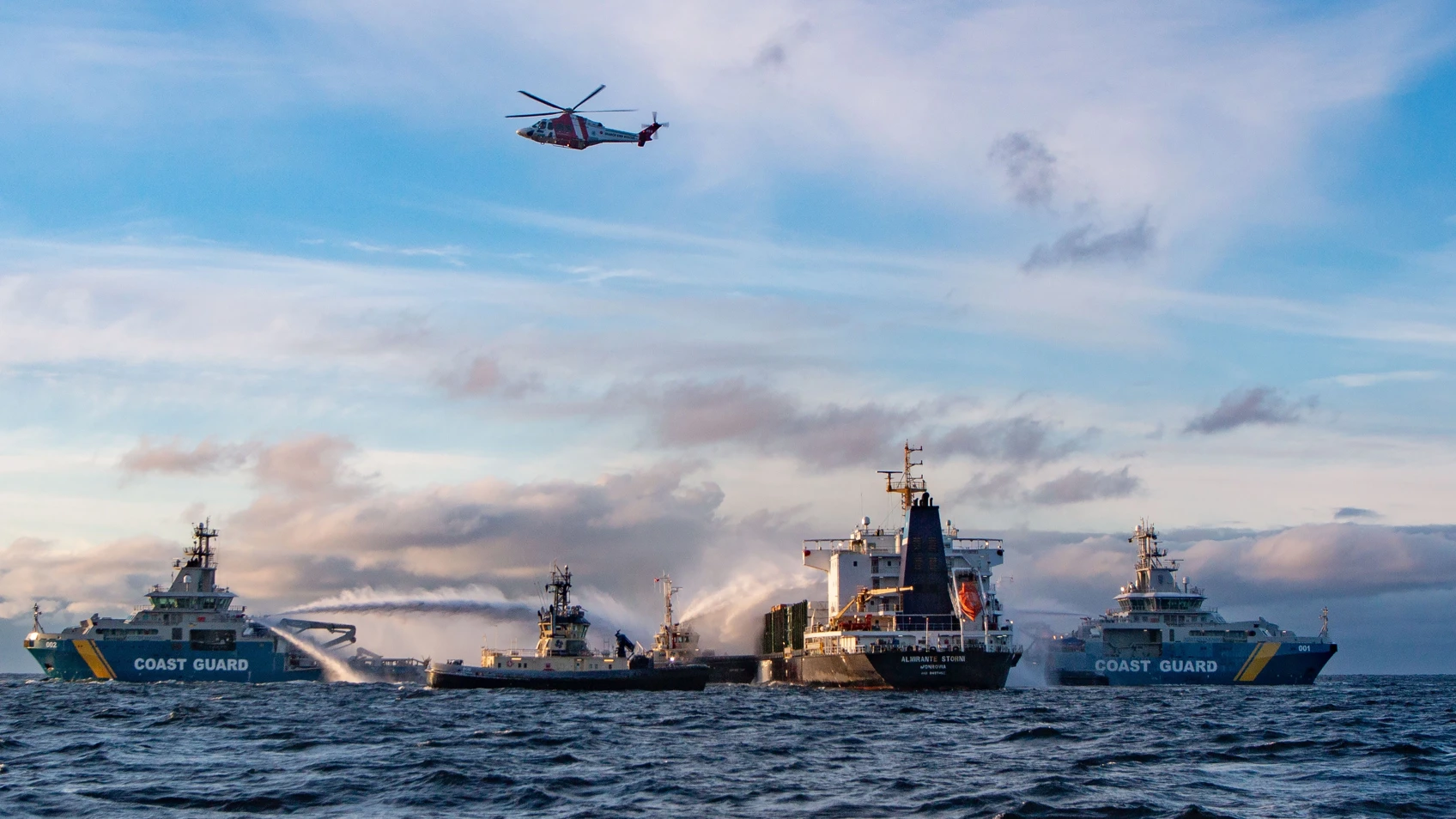
On the afternoon of Saturday 4 December 2021, a fire broke out in the tightly packed timber on the Liberian-flagged cargo ship Almirante Storni while it was bunkering at Vinga off Gothenburg. Flames came out from the cargo deck. The fire was deep inside the cargo and the water cannons could not hit the seat of the fire directly, which made the fire very hard to put out.
The Swedish Coast Guard was quickly on the scene with KBV 310 and began to extinguish the burning cargo together with the rescue services, the Swedish Sea Rescue Society and private actors. The Coast Guard's role was pollution response at sea. The focus was on protecting the environment and property by getting the fire under control, so that the vessel could be brought to the quayside.
Specially trained firefighters from Gothenburg and Karlskrona were on board the damaged vessel under the command of the Coast Guard. With the help of a tug, the vessel was turned with the wind to limit the spread of the fire. To prevent an environmental disaster, resources were focused on dampening the fire and protecting the vessel's 600 tonnes of fuel.
More units come to help
The day after the fire started, the Coast Guard's largest combination vessel, KBV 001 Poseidon, joined the scene and took part in the rescue work. On the second day, the Coast Guard, together with tugs and the Swedish Sea Rescue Society, continued to pump large amounts of water over the burning timber on board Almirante Storni, which lay at anchor off Vinga. KBV 002 Triton came from Gotland and helped with the rescue work. The Coast Guard's aircraft photographed the fire from above with a thermal camera to identify the hottest areas.
The fire cannot be put out
On the third day of the fire, the situation was static. The water bombardment had a dampening effect, but it was difficult to reach the seat of the fire. The firefighting units had control and the fire did not spread. The Coast Guard also prepared to lighten the fuel in the tanks if necessary. At this point there was no immediate danger to life and health, so the master and the whole crew stayed on board together with a Coast Guard Member and several specially trained firefighters. The vessel was still operational, but with some limitations.
Harsh weather
The weather in December 2021 was not at its best for the rescue operation. The sea was rough, south-easterly winds blew at just under 12 metres per second and the thermometer showed a few degrees below zero. The harsh weather put heavy strain on both crews and equipment. The vessels fighting the fire were heavily iced up.
Help from Norway
On the fifth day of the fire, there were signs of heat spreading in the cargo, which was serious. There was an increased risk of escalation, and risks for the vessel, which had 600 tonnes of fuel on board. Under the Bonn Agreement, a cooperation on sharing resources in pollution response operations in the North Sea area, the Coast Guard asked Norway for help. Our neighbouring country responded and sent one of its coast guard vessels, with a capacity to fight large-scale fires equivalent to that of the Swedish Coast Guard's vessels.
The Norwegian Coast Guard's KV Bergen arrived on Wednesday 8 December. So did the offshore vessel Viking Loke, which was chartered by the salvage company hired by Almirante Storni's shipping company. Viking Loke took part in the firefighting under the command of the Coast Guard.
Preliminary investigation and salvage
While the firefighting was under way, a preliminary investigation took place into what could have caused the fire. Prosecutors held informal interviews on board Alimrante Storni, and the Coast Guard assisted the prosecutor in carrying out these measures.
On the morning of Saturday 11 December, one week after the fire started, work began to move Almirante Storni from the anchorage off Vinga to Skandiahamnen in Gothenburg. A move like this involved many risks and required many resources. After receiving help to weigh anchor, Almirante Storni went under its own power to Skandiahamnen in Gothenburg, assisted by tugs to ensure a safe passage. During the move, the Coast Guard's combination vessels KBV 001 Poseidon and KBV 002 Triton stood by at heightened preparedness in case complications arose. The Coast Guard's vessels also continued the firefighting during the transport.
A good ending
The salvage went entirely to plan. Almirante Storni sailed with its burning cargo under its own power at just under four knots to Skandiahamnen in Gothenburg. Once at the quayside, images from a police helicopter showed that the cargo was still burning. The municipal rescue services then took over responsibility for the firefighting.
No one was injured during the rescue work and there were no releases of hazardous substances. However, the vessels were damaged during the firefighting.
The handling of the fire on Almirante Storni was one of the most extensive in modern times in Sweden.