
The oil spill from the passenger ferry Marco Polo in 2023
On Sunday 22 October 2023, TT-Line's passenger ferry Marco Polo ran aground south of Karlshamn, in Pukaviksbukten, Blekinge. The accident caused a large heavy oil spill and led to a major government rescue operation. Together with several other parties, the Swedish Coast Guard worked for 19 days to clean up oil.
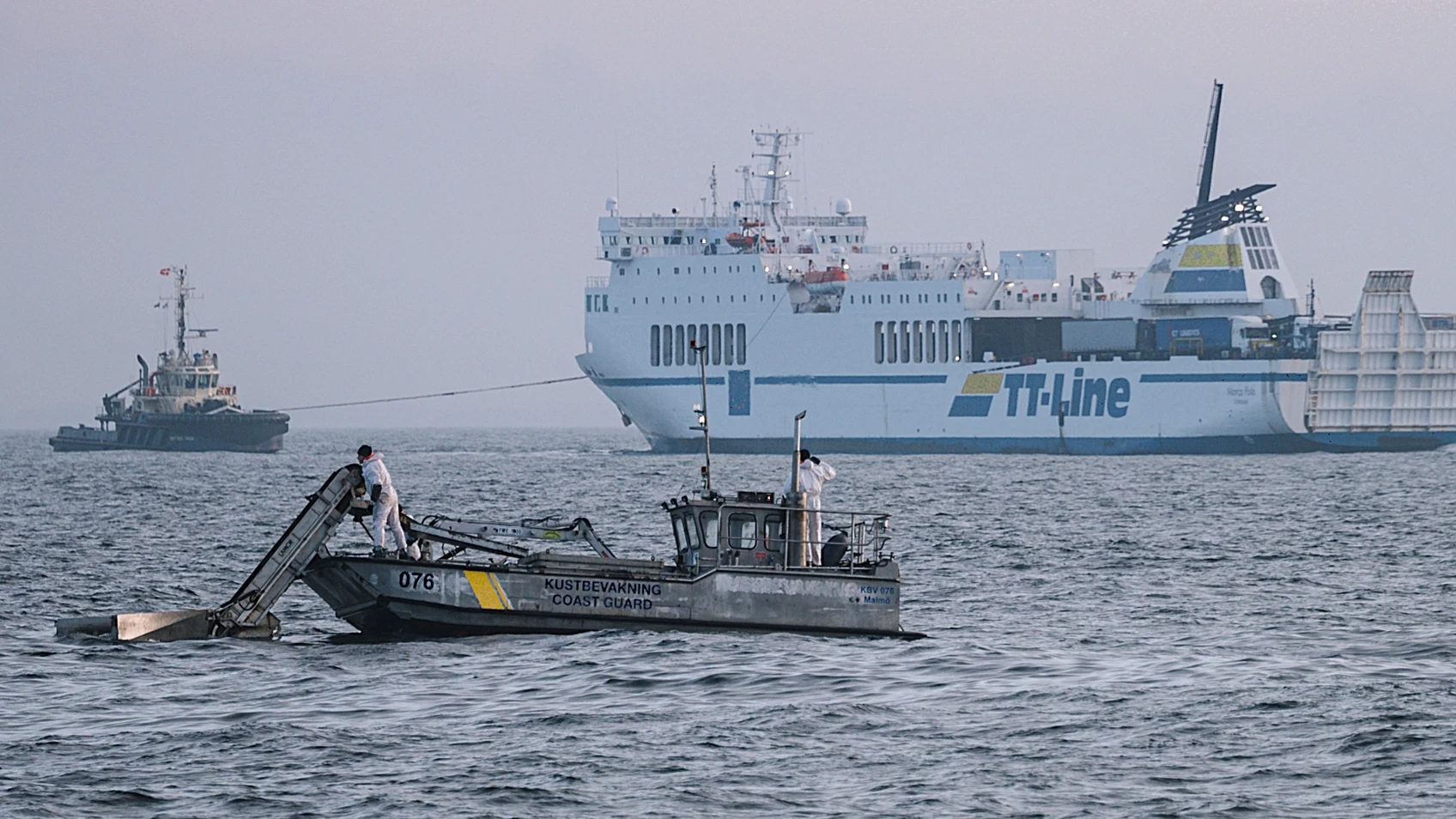
On Sunday morning, TT-Line's ferry Marco Polo, with 75 passengers on board, ran aground south of Karlshamn. The vessel passed on the wrong side of a sea mark by the shoal Laxören. It continued a short distance before it stopped completely, east of the lighthouse Lörbykladd. After an alarm about water entering the vessel, the operation started as a maritime search and rescue operation to evacuate the passengers. It then became a pollution response operation. The Swedish Sea Rescue Society evacuated the passengers. Together with the Coast Guard's combination vessel KBV 003 Amfitrite, it laid a boom around the vessel to stop oil and diesel from spreading in the surrounding area. KBV 034 also made its way to the scene of the accident on this first day.
Stuck on the shoal
After the grounding, the vessel stood stable on the shoal. There was heavy fog in the area, which made it harder to get a clear picture of the spill. Images taken by the Coast Guard air patrol showed that, besides the spill around the vessel, there was a strip with a larger amount of oil south of the damaged vessel. Marco Polo had already run aground earlier in the morning. It had leaked oil for several nautical miles before it ran onto the shoal, where it stuck fast.
Pollution response and criminal investigation
The Coast Guard worked on two parallel tracks: pollution response and a criminal investigation. The offences were classified as offences against the Swedish Maritime Code and offences against the Act on Measures against Pollution from Ships (SFS 1980:424).
Despite light wind, about 3–4 metres per second from the east, the oil drifted towards a sensitive stretch of coast, half a nautical mile long, at Pukaviksbukten between Lörby Kladd and Hörvik in Sölvesborg municipality, Blekinge. The Coast Guard reinforced with staff and units from all over southern Sweden to fight the spills. It did so in cooperation with, among others, the then Swedish Civil Contingencies Agency, now Swedish Civil Defence and Resilience Agency, the Swedish Sea Rescue Society, the Swedish Transport Agency, the Swedish Maritime Administration, the Swedish Auxiliary Naval Corps, the local rescue service, the Home Guard and many others. Pollution response was the priority: to recover as much oil as possible from the water and, as far as possible, save the shores. It was easier to recover the oil at sea. Oil that had reached land would take a long time to clear.
We are responsible for and lead a pollution response and a criminal investigation, while also taking part in a rescue of 75 passengers. There are many threads to hold together.
Kalle, Response Commander
When oil sinks it is harder to recover
Two days into the accident, the weather got worse. This made oil recovery at sea harder, and more oil was expected to reach the shore. The worse weather also affected the oil. It began to sink below the surface and appeared as a thick emulsion. Coast Guard divers found oil in the water column, that is, in a layer below the surface, around the damaged vessel. These factors make it harder to fight the spill at sea. The vessels working on the operation were directed from the air. The Coast Guard air patrol flew over the area often.
On Tuesday evening, almost all the oil that had leaked from Marco Polo had sunk below the water surface. It was therefore no longer possible to recover the oil at sea. At the same time, the weather conditions kept getting worse. There was a risk that the oil would drift towards both the coast of Blekinge and Åhus in Skåne. The Coast Guard therefore divided its units between the two coasts.
Suspicion of crime
The Coast Guard's criminal investigation showed that there were probable grounds to suspect an offence. The suspicion was directed at two members of the crew who had acted negligently in connection with the two groundings.
Clean-up near land
After the oil had sunk and could no longer be recovered at sea, the Coast Guard worked close to the shore to recover oil. It worked side by side with the local rescue service, which was responsible for the oil that had come ashore. The oil was mainly on the shores from Hörvik to Lörby kladd. Fortunately, the oil never reached the coast of Skåne.
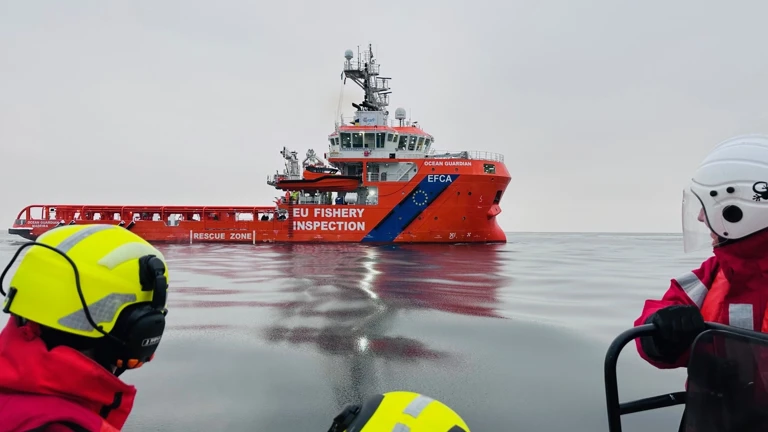
Two oil recovery vessels were also borrowed from EMSA, the European Maritime Safety Agency. They could recover the oil that had sunk below the water surface, where it cannot be seen and cannot be cleaned up with the Coast Guard's oil recovery systems.
Salvage
Almost a week after the grounding, on Saturday 28 October, the shipping company gave the Coast Guard and the Swedish Transport Agency a first salvage plan. The same day, the shipping company also provided a tanker to empty the remaining oil from the damaged vessel.
On Sunday 29 October, Marco Polo slid off the shoal. The Swedish Maritime Administration's Joint Rescue Coordination Centre, JRCC, led an evacuation in which the Coast Guard took part with several units.
At the same time, the Coast Guard's pollution response operation continued throughout. Its aim was to limit and fight both the earlier oil and the new oil released from the damaged vessel. This oil was now drifting back towards Norje in Pukaviksbukten and Karlshamn, Blekinge.
On Tuesday 31 October, the shipping company presented a new salvage plan. The Coast Guard argued that the salvage should start in daylight, because there was a risk of further oil spills and other incidents during the salvage. The damaged vessel was to be taken to Stillerydshamnen in Karlshamn, which was prepared to receive the ferry.
How the salvage was carried out
- On Thursday 2 November, Marco Polo was towed to Stillerydshamnen in Karlshamn. The trip took about four hours and went without complications or new oil spills.
- Two tugboats were connected to the vessel, one at the bow and one at the stern, to stabilise the vessel.
- The vessel was pressurised to keep it afloat, that is, floating off the shoal.
When the vessel was afloat, Marco Polo was towed out into deeper water so that it could be anchored. - When the anchoring was secure, new surveys of the hull were carried out to get a full picture of the damage. It had not been possible to inspect the whole hull earlier, because the vessel and hull had been aground.
- The Coast Guard stayed at Pukaviksbukten to deal with oil that had leaked earlier and might come up to the sea surface. We surveyed the area again by aircraft and vessel to see whether any visible oil was at sea. We also dived at different places to see what it looked like below the surface, and we used drones to search the area.
The operation ends
On Friday 10 November, KBV 003 escorted the damaged vessel Marco Polo from Karlskrona to the limit of the Swedish economic zone. There, a Polish maritime search and rescue unit met it and continued the escort to Gdansk in Poland.
Once the vessel had left the Swedish economic zone, the Coast Guard ended its environmental rescue services in operation Marco Polo. It was the largest and most complicated rescue operation that the Coast Guard has had in modern times.
Quick facts about the pollution response operation
- Over 4 kilometres of boom have been laid out
- In total, about 75 people from the Coast Guard are on site
- Aircraft and drones are used in the air
- Rescue divers for light and heavy diving in contaminated water
- In total, about 50 cubic metres of oil were recovered
- Vessels on site:
KBV 003 Amfitrite, combination vessel
KBV 034, pollution response vessel
KBV 314, patrol vessel
5 shallow water protection units
4 marine trailers with 500 metres of boom on each trailer
Several smaller work boats for moving staff