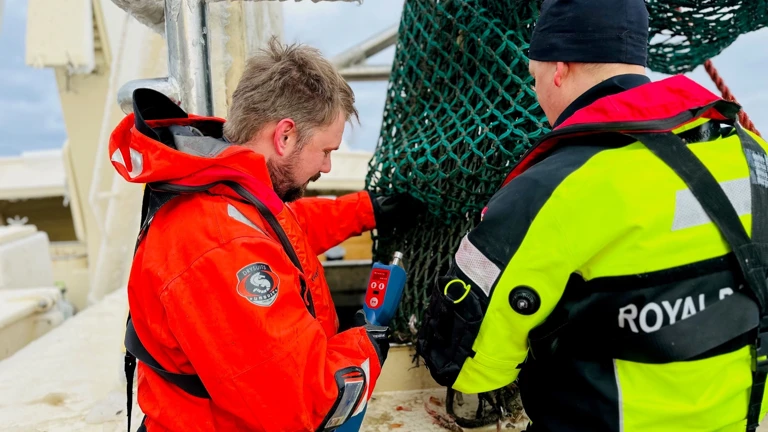

Speed surveillance
How fast may you go at sea? On the open sea there are often no speed limits, but boat drivers must always show good seamanship and adapt their speed to the circumstances.
At harbour entrances or narrow passages, for example, there may be speed limits to increase safety and to protect other traffic, the environment and wildlife. You see these speed limits on signs that show the maximum permitted speed. Sometimes the same speed limit applies to all types of boats, but there may also be different speed limits on the same stretch. In that case, additional signs show who the speed limit applies to. A speed limit can also apply during a certain time of year.
Fixed penalty, report or waiver of report
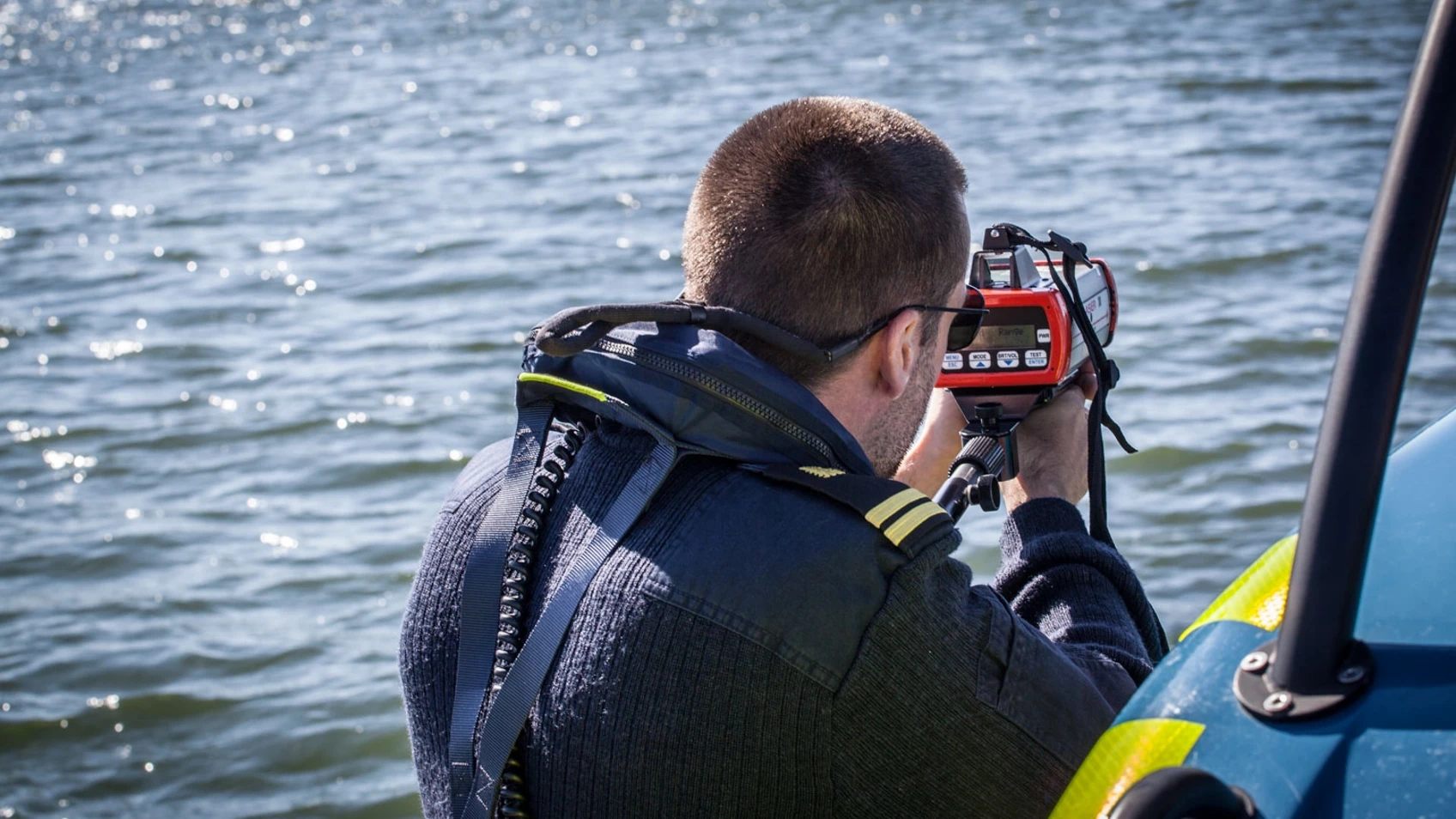
For speed surveillance at sea, the Swedish Coast Guard mainly uses laser speed guns. The Coast Guard applies the Swedish National Police Board's regulations and general advice on speed surveillance. In Sweden, speed at sea is stated in knots.
A speeding offence can result in a fixed penalty, a report or a waiver of report.
A coast guard officer issues a fixed penalty on the spot. The amount of the fine depends on the speeding offence.
Up to 5 knots over the applicable speed limit: SEK 1,000
6-10 knots: SEK 1,500
11-15 knots: SEK 2,000
16-20 knots: SEK 2,500
21-25 knots: SEK 3,000
A report is written, for example, if the suspect cannot show an ID document, does not want to accept the fixed penalty, or if the speeding offence is more than 25 knots over the limit, which as a rule is regarded as negligence at sea. The report leads to a criminal complaint and is handled by a prosecutor.
A waiver of report is used in cases where a warning can be considered enough.
Unnecessarily disturbing driving, an alternative to negligence
It is an offence under the Swedish Maritime Code to disturb the surroundings at sea unnecessarily.
"A person who takes such a route, keeps such a speed or otherwise travels with a vessel in such a way that he unnecessarily disturbs the surroundings may be sentenced to a fine", as stated in the Swedish Maritime Code, chapter 20, section 3.
Examples of activities that can be judged as disturbing driving:
- Driving that creates large wakes and causes problems for other boats, people swimming or people on land.
- Driving at night in a way that takes you unnecessarily close to other boats or to people living on land.
- Loud engine noise near a bird protection area.
The County Administrative Board decides on speed limits
The County Administrative Board decides on speed limits at sea. These are found in its Maritime Traffic Regulations, which each County Administrative Board issues.
If you have questions about current speed limits in the archipelago, contact the County Administrative Board in the area concerned.