
Oil spills at sea
The Swedish Coast Guard has an important role in protecting the marine and coastal environment against spills of oil and other harmful substances. Through surveillance, preparedness and pollution response operations, we work to quickly detect and limit spills and reduce their impact on the environment.
When oil is spilled at sea in Swedish waters, or in the large Swedish lakes Vänern, Vättern and Mälaren, the Swedish Coast Guard is responsible for limiting the spill and tackling it by recovering the oil from the water.
Our task is to prevent, detect and tackle pollution in Swedish waters. We also make sure that oil is dealt with as early and as effectively as possible to minimise the damage.
Our operations are always on standby. We work with other authorities, countries and international organisations so that we are ready to act if a spill occurs.
How the Coast Guard works
When an oil spill occurs, our first task is to locate the spill quickly and assess its extent. In many cases we do this with the help of aerial surveillance. This allows us to quickly map where the oil is and how it is moving.
Next, the response work begins. First we must stop or limit the source of the spill, for example a damaged vessel, and then prevent the oil from spreading further. We do this by placing booms around the oil to keep it within a controlled area.
Once the oil has been contained, recovery begins. It is important to start the work as early as possible, while the oil is still liquid and relatively easy to handle. The more time that passes, the harder it becomes to collect the oil, especially if it emulsifies, sinks or reaches land.
The oil that is recovered is stored temporarily on board our response vessels before it is transported to land. There it is dealt with at special facilities, where it is usually destroyed.
In the case of very large spills or complicated incidents, we can quickly request support from other countries through our international cooperation.
Several factors affect the possibility of tackling a spill
Oil that comes into contact with air and water can go through a number of different processes that change its properties.
One property that affects how oil is handled is viscosity, that is, how thick and slow-flowing the oil is. It varies between different types of oil and is affected by, for example, water and air temperature. A lower temperature gives higher viscosity and a thicker layer, while a higher temperature gives lower viscosity and a thinner layer. When the oil becomes thicker, it is also harder to handle during response work. A lower temperature can also make the oil sink below the water surface or freeze into blocks of ice.
The oil can spread with currents, break up or stick to sediment that then sinks to the bottom. Depending on the type of oil, it can also partly mix with water and form an emulsion, which makes the response work even harder.
When oil spreads in the water, it can quickly cover large areas. Even though the oil is broken down over time by sun, wind and microorganisms, the process can take a very long time, especially in cold seas or sheltered areas with low water exchange. Oils with low density, for example diesel, can easily spread over large areas but evaporate quickly.
Handling an oil spill at sea is difficult, but it is even harder to tackle once it has reached land. It is therefore of the utmost importance to clean up a spill as quickly as possible.
Winter conditions: a special challenge
During the winter months, completely different demands apply. Low temperatures affect both the properties of the oil and our ability to work effectively. When ice forms, the oil can become trapped and difficult to detect. Weather conditions make it harder and limit our ability to use normal equipment, such as booms.
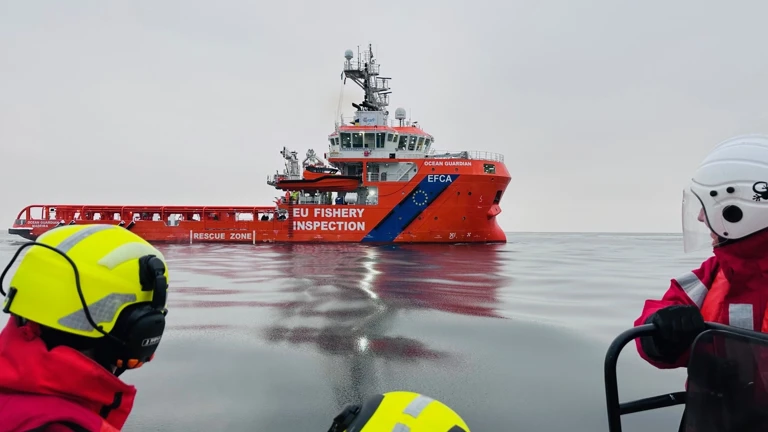
In these situations, other methods are needed. The Coast Guard has access to icebreaking vessels, infrared sensors and other specialist equipment to locate and recover oil under the ice. Our long experience of working in northern waters gives us the knowledge and capacity to handle spills even in difficult winter conditions.
FAQ
If the oil reaches land, or if a spill occurs in water within a municipality's area of responsibility, for example in watercourses or in harbours, the municipal rescue service is responsible for the pollution response. Swedish Civil Defence and Resilience Agency supports the municipalities in the overall coordination of oil protection on land.
To handle oil spills effectively, the Coast Guard has access to, among other things:
- Response vessels and combination vessels: purpose-built vessels equipped for oil recovery and pollution response operations
- Aircraft and drones: used for surveillance, documentation and command of operations
- Booms: floating barriers that limit the spread of oil
- Brushes, pumps and scoops: used to collect oil from the surface
- Oil trawls: catch oil that has sunk below the surface
- Collection tanks: for storing oil on board until it can be delivered to land
- Clean-up equipment: for work on the coast and on land
To reduce the risk of spills, we also work to prevent them. Among other things, this means that we monitor maritime traffic, analyse risks and are ready to act in incidents such as a grounding or engine failure that risks leading to a spill.
We have a high level of preparedness all year round. Preventive work is just as important a part of our mission as the response to a spill itself.
A spill can threaten important societal functions. For example, several Swedish nuclear power plants depend on clean cooling water from the sea. Many of our raw water intakes for drinking water are also located in state-owned water areas that can be affected by a larger spill.
Being able to act quickly in the event of an oil spill is therefore an important part of Sweden's overall crisis preparedness.
As maritime traffic increases, the risk of oil spills also grows. Transports of large quantities of oil and other harmful substances through sensitive and often shallow waters, for example in the Baltic Sea, increase both the threat level and the need for cooperation. Vessels under new flag states and with limited experience of navigating in our waters add to the risks.
Read more about the risks of the so-called shadow fleet.
International cooperation is necessary to handle larger spills, and we at the Coast Guard work with several organisations and networks. Within the Helsinki Commission (HELCOM), we coordinate pollution response in the Baltic Sea. The Bonn Agreement covers the countries around the North Sea, and the Copenhagen Agreement is a cooperation between the Nordic countries. Through the EU's maritime safety agency EMSA, we can also get access to extra resources and expertise when needed.
Together we carry out joint exercises, share knowledge and develop common methods to be better prepared when accidents happen.
As a boat owner, you must make sure that fuel, lubricating oil or other polluting liquid is not released into the water. Even small spills can cause damage, and there is no lower limit for what is allowed.
If you cause a spill, you may be liable to pay the Coast Guard's costs. It is therefore important to act responsibly, check your equipment and be careful when handling oil and fuel.
Read more about how you as a boat owner can prevent an oil spill.